Publications

You can also find my articles on my Google Scholar profile.

NSDI | 2026

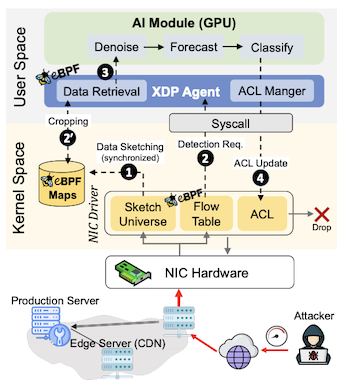
Defeating Slow-and-Low Threats via Diffusion Model-Based Generative Inference

Seyed Mohammad Mehdi Mirnajafizadeh, Prashant Khanduri, DaeHun Nyang, Rhongho Jang
USENIX Symposium on Networked Systems Design and Implementation (NSDI)
Abstract: Content Delivery Networks (CDNs) are known to be vulnerable to slow-and-low threats that exploit trusted protocols while evading threshold-based defense at the edge. Our work addresses three limitations at edge defense: constrained resources, absence of a behavior monitor, and impractical assumptions for online detection. To defeat slow-and-low threats, we propose SketchVision, a vision-inspired detection framework that redefines flow behavior monitoring and attack detection under resource-constrained settings. We introduce a vision-inspired sketch that encodes packet-level temporal patterns of all flows into a compact image, a diffusion model tailored for sketch denoising, and a generative inference pipeline to forecast mature flow states from partial observations for early detection. Implemented with eBPF-enabled data planes and diffusion-based control, SketchVision achieves robust accuracy across 19 types of slow-and-low attacks, reaching an average AUC of 0.982 and F1 score of 0.913, improving detection by up to 29% over the state-of-the-art methods, while remaining efficient for large-scale CDN edge deployment.
@inproceedings{mirnajafizadeh2026defeating, title={Defeating Slow-and-Low Threats via Diffusion Model-based Generative Inference}, author={Mirnajafizadeh, Seyed Mohammad Mehdi and Khanduri, Prashant and Nyang, DaeHun and Jang, Rhongho}, booktitle={23rd USENIX Symposium on Networked Systems Design and Implementation (NSDI 26)}, pages={1053--1072}, year={2026} }
NDSS | 2025

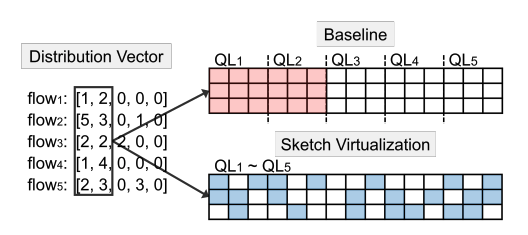
SketchFeature: High-Quality Per-Flow Feature Extractor Towards Security-Aware Data Plane

Sian Kim, Seyed Mohammad Mehdi Mirnajafizadeh, Bara Kim, Rhongho Jang, DaeHun Nyang
Network and Distributed System Security (NDSS) Symposium
Abstract: Intelligent Network Data Plane (INDP) is emerging as a promising direction for in-network security due to the advancement of machine learning technologies and the importance of fast mitigation of attacks. However, the feature extraction function still poses various challenges due to the multiple hardware constraints in the network data plane, especially for the advanced per-flow 3rd-order features (e.g., inter-packet delay and packet size distributions) preferred by recent security applications. In this paper, we discover novel attack surfaces of state-of-the-art data plane feature extractors that had to accommodate the hardware constraints, allowing adversaries to evade the entire attack detection loop of the in-network intrusion detection systems. To eliminate the attack surfaces fundamentally, we pursue an evolution of a probabilistic (sketch) approach to enable flawless 3rd-order feature extraction at the data plane, highlighting High-resolution, All-flow, and Full-range (HAF) 3rd-order feature measurement capacity. To our best knowledge, the proposed scheme, namely SketchFeature, is the first sketch-based feature extractor fully deployable in the data plane. Through extensive analyses, we confirmed the robust performance of the proposed feature extractor theoretically and experimentally. Furthermore, we ran two security use cases, namely covert channel and DDoS detections, with SketchFeature as the feature extractor, and achieved near-optimal attack detection performance with machine learning.
@inproceedings{Kim2025SketchFeature, author = {Sian Kim and Seyed Mohammad Mehdi Mirnajafizadeh and Bara Kim and Rhongho Jang and DaeHun Nyang}, title = {SketchFeature: High-Quality Per-Flow Feature Extractor Towards Security-Aware Data Plane}, booktitle = {Proc. of ISOC {NDSS}}, year = {2025} }
arXiv | 2025

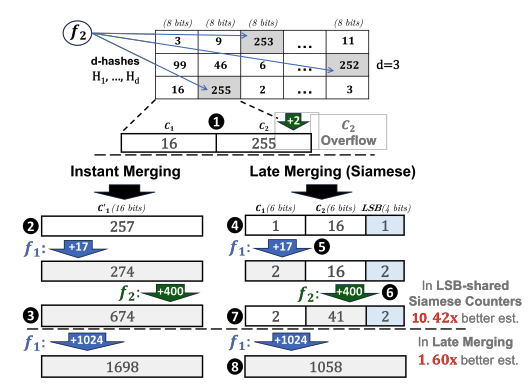
Enhancing Resiliency of Sketch-based Security via LSB Sharing-based Dynamic Late Merging

Seungsam Yang†, Seyed Mohammad Mehdi Mirnajafizadeh†, Sian Kim, Rhongho Jang, DaeHun Nyang (†equal contribution)
arXiv:2503.11777
Abstract: With the exponentially growing Internet traffic, sketch data structure with a probabilistic algorithm has been expected to be an alternative solution for non-compromised (non-selective) security monitoring. While facilitating counting within a confined memory space, the sketch's memory efficiency and accuracy were further pushed to their limit through finer-grained and dynamic control of constrained memory space to adapt to the data stream's inherent skewness (i.e., Zipf distribution), namely small counters with extensions. In this paper, we unveil a vulnerable factor of the small counter design by introducing a new sketch-oriented attack, which threatens a stream of state-of-the-art sketches and their security applications. With the root cause analyses, we propose Siamese Counter with enhanced adversarial resiliency and verified feasibility with extensive experimental and theoretical analyses. Under a sketch pollution attack, Siamese Counter delivers 47% accurate results than a state-of-the-art scheme, and demonstrates up to 82% more accurate estimation under normal measurement scenarios.
@article{yang2025enhancing, title={Enhancing Resiliency of Sketch-based Security via LSB Sharing-based Dynamic Late Merging}, author={Yang, Seungsam and Mirnajafizadeh, Seyed Mohammad Mehdi and Kim, Sian and Jang, Rhongho and Nyang, DaeHun}, journal={arXiv preprint arXiv:2503.11777}, year={2025} }
SEC | 2024

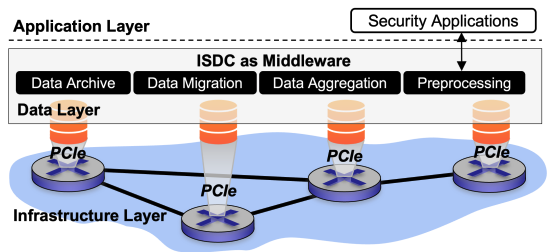
Enhancing Network Attack Detection with Distributed and In-Network Data Collection System

Seyed Mohammad Mehdi Mirnajafizadeh, Ashwin Raam Sethuram, David Mohaisen, DaeHun Nyang, Rhongho Jang
USENIX Security Symposium
Abstract: The collection of network data poses a significant challenge for machine/deep learning-driven network defense systems. This paper proposes a new paradigm, namely In-network Serverless Data Collection (ISDC), to eliminate the bottleneck between network infrastructure (where data is generated) and security application servers (where data is consumed). Considering the extremely mismatched scale between traffic volume and in-network resources, we stress the need to prioritize flows based on the application’s interests, and a sublinear prediction algorithm is proposed to prioritize specific flows to optimize resource consumption effectively. Additionally, a negotiation-free task migration mechanism with task-data isolation is introduced to allocate tasks dynamically across the network to enhance resource efficiency. Furthermore, ISDC incorporates a serverless data migration and ag- gregation mechanism to ensure data integrity and serves as a reliable and distributed data source for network defense systems. We present two use cases to demonstrate the feasibility of ISDC, namely covert channel detection and DoS/DDoS attack detection. In both scenarios, ISDC achieves significantly higher flow coverage and feature accuracy compared to existing schemes, leading to improved attack detection accuracy. Remarkably, ISDC’s data integrity addresses a model selfpoisoning issue caused by duplicated and fragmented flow measurements generated during collaborative measurements.
@inproceedings{mirnajafizadeh2024enhancing, title={Enhancing Network Attack Detection with Distributed and In-Network Data Collection System}, author={\textbf{Seyed Mohammad Mehdi Mirnajafizadeh} and Ashwin Raam Sethuram and David Mohaisen and DaeHun Nyang and RhongHo Jang}, booktitle={Proc. of USENIX Security}, year={2024} }